
Goldenrod: A Case of Mistaken Identity
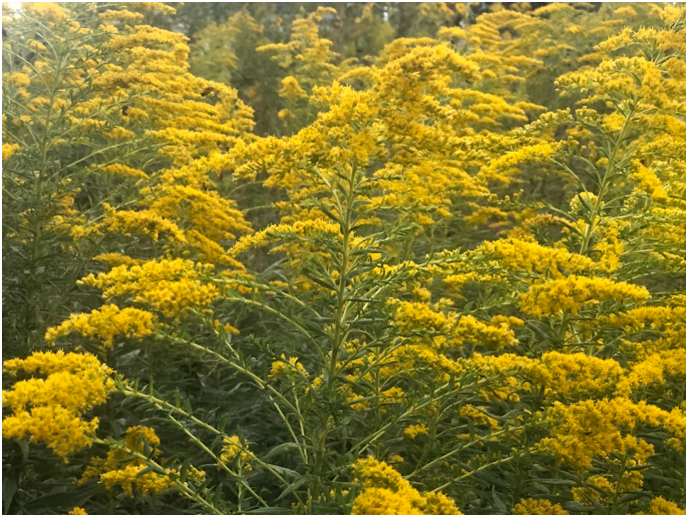
The aggressive but beautiful Canada goldenrod.
We are getting into that goldenrod time of year. During my recent trip to that state up north, goldenrod was in its full glory on Mackinac Island and throughout the Upper Peninsula. Much of what I saw up there was early goldenrod (Solidago juncea), a fitting name for a species that begins flowering a bit ahead of many of its late-summer and fall-blooming relatives.
There are many species of goldenrod (Solidago spp.), and Ohio is well represented. Canada goldenrod (Solidago canadensis) is widely distributed across the state, while early goldenrod is most common in eastern and northeastern Ohio, although it can be found across much of the state. Central Ohio Metro Parks notes that Ohio has about 25 native goldenrod species, including species associated with prairies, wetlands, woodlands, old fields, and roadsides.
Goldenrod is beautiful, but it is much more than a pretty yellow flower. It is one of our most important late-season pollinator plants. When many summer flowers are winding down, goldenrod provides nectar and pollen for bees, wasps, butterflies, moths, beetles, flies, and other beneficial insects preparing for migration, reproduction, or winter survival. It is also the state flower of Kentucky, which gives those of us working along the Ohio River one more reason to appreciate it.
The Allergy Accusation
Despite all of its benefits, goldenrod has a bad reputation. A large percentage of the population believes goldenrod causes allergies and hay fever. After all, people begin sneezing and coughing at the same time those bright golden-yellow flowers appear in fields, along roadsides, and at the edges of gardens. The timing seems suspicious.
But this is a classic case of mistaken identity. Goldenrod pollen is relatively heavy, sticky, and adapted for insect transport. Goldenrod is not primarily wind-pollinated. Its pollen must be picked up on the bodies of visiting insects and moved from flower to flower. Because it is too heavy and sticky to blow freely through the air, it is not floating around in clouds waiting to cause widespread allergy symptoms.
That does not mean a person could never react to direct contact with goldenrod, especially if they are handling flowers closely. However, when we are talking about the regional hay fever season, goldenrod is usually an innocent bystander.
The Real Culprit: Ragweed
So why are people sneezing and coughing when those yellow flowers are in bloom? Many of you know the answer, but I am certain many of our clients do not. At the same time goldenrod is flowering, another plant is also blooming. It is prolific. It is widespread. It may be growing in your neighborhood, along the roadside, near field edges, in vacant lots, or even in your own backyard. Yet many people never notice it because the plant is green and its flowering parts are green.
That plant is ragweed (Ambrosia spp.). Ragweed is wind-pollinated, and it produces enormous quantities of very small, lightweight pollen. This pollen is designed to move through the air. It can travel long distances, remain suspended, and readily enter the respiratory system of sensitive individuals. Ragweed pollen has even been detected far from land, illustrating just how readily it can move with air currents.
In short, goldenrod gets blamed because it is visible. Ragweed is guilty because it is airborne.
Ragweed Species in Ohio
Several ragweed species may be encountered in Ohio, but the most commonly recognized and most important allergy-producing species include common ragweed (Ambrosia artemisiifolia) and giant ragweed (Ambrosia trifida). Pollen references for Ohio also list lance-leaf ragweed (Ambrosia bidentata) among ragweed species documented in the state.
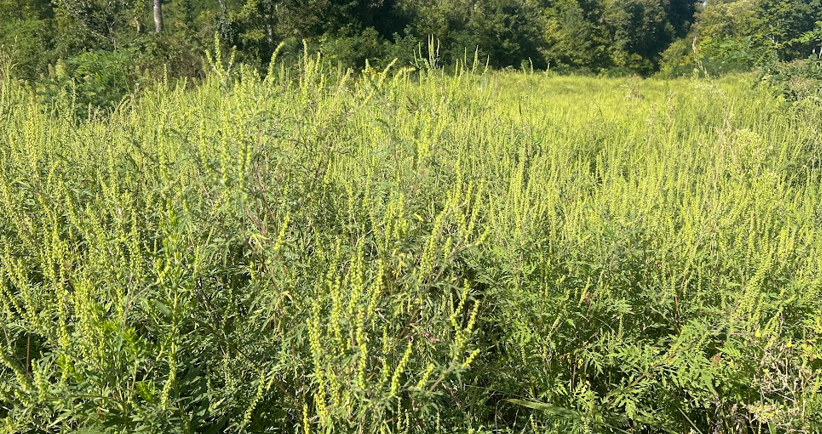
Common ragweed.
Common ragweed (Ambrosia artemisiifolia) is usually the plant people fail to notice. It has finely divided, fern-like leaves and small, inconspicuous green flower spikes. It is common along roadsides, field margins, disturbed soils, urban edges, and neglected landscape areas.
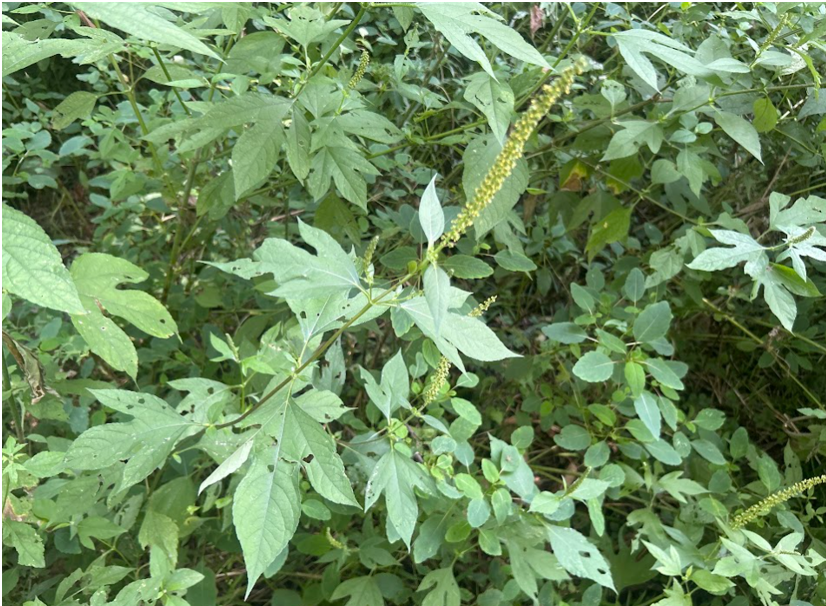
Giant ragweed.
Giant ragweed (Ambrosia trifida) is much more imposing and may reach impressive heights in rich, moist soils. Its leaves are large, typically three- to five-lobed, and opposite on young growth. It is common in agricultural areas, riparian corridors, low ground, disturbed sites, and moist soils. Both species are wind-pollinated and both contribute to the late-summer and fall allergy season.
The easiest way to explain the difference to clients is visual and biological: goldenrod has showy yellow flowers that attract insects; ragweed has small green flowers that release pollen into the wind. The plant you see is not necessarily the plant you are breathing.
Garden-Worthy Goldenrods
This case of mistaken identity is unfortunate because goldenrod is both beneficial and beautiful. Some goldenrods, including Canada goldenrod, spread by rhizomes and can be quite the bully. I have lots of Canada goldenrod in my garden area. I know it is a bully, but it is beautiful. Occasionally, I need to beat it back. I did not plant it, but I let it do its thing until it gets carried away.
Fortunately, a number of cultivated selections are much better behaved and fit very nicely into designed landscapes and native plant gardens. ‘Fireworks’ goldenrod (Solidago rugosa ‘Fireworks’) is one of the best-known and commonly available cultivars. It has graceful, arching sprays of yellow flowers and is generally more garden-worthy than the most aggressive rhizomatous species.
‘Solar Cascade’ is a particularly interesting goldenrod selection because it was developed from short’s goldenrod (Solidago shortii), a federally endangered species known from limited natural populations in northern Kentucky and southeastern Indiana. Using ‘Solar Cascade’ in cultivation helps bring attention to this rare regional species and demonstrates how horticulture can support conservation awareness when plants are responsibly propagated and marketed.
Other goldenrods that are frequently available through native plant nurseries, specialty garden centers, or regional plant sales include little lemon goldenrod (Solidago ‘Little Lemon’), golden fleece goldenrod (Solidago sphacelata ‘Golden Fleece’), blue-stemmed goldenrod (Solidago caesia), zigzag goldenrod (Solidago flexicaulis), gray goldenrod (Solidago nemoralis), showy goldenrod (Solidago speciosa), stiff goldenrod (Solidago rigida or Oligoneuron rigidum), Ohio goldenrod (Solidago ohioensis), and wreath goldenrod (Solidago caesia). Availability varies by nursery, but the list of garden-worthy goldenrods continues to grow as demand for native perennials increases.
Teach the Plant, Not the Myth
If your garden center carries native plants, I strongly encourage you to include goldenrod in the mix. Just as importantly, include education about the plant. Let clients know that goldenrod is not the plant responsible for most late-season hay fever symptoms. Show them the difference between goldenrod and ragweed. Explain insect pollination versus wind pollination. Help them understand that removing goldenrod will not solve a ragweed pollen problem, but it may remove an important food source for pollinators.
Goldenrod deserves better than its undeserved reputation. It is a late-season keystone plant, a beautiful addition to naturalized landscapes, and a bridge between horticulture, ecology, and client education. Make the pollinators happy, teach the difference between goldenrod and ragweed, and enjoy the fall.